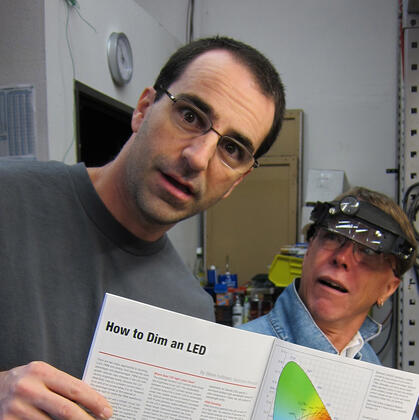
Hi, Al DeMayo here.
Al DeMayo’s career has unfolded at the intersection of filmmaking, electronics, and invention. From his earliest days on motion-picture sets to his role in transforming LED lighting for the screen, his work has been guided by the same instinct: when filmmakers need a tool that does not yet exist, find a way to build it.Early YearsAl grew up in Burbank, California, surrounded by the physical presence of the entertainment industry. Studios, equipment houses, soundstages, and production crews were part of the world around him. Movies were not simply something projected onto a screen; they were made nearby by working craftspeople using real equipment, practical skills, and considerable ingenuity.His interest in technology took shape in a high-school electronics class. Electronics offered him a way to understand what was happening beneath the surface—how individual components could be assembled into a functioning system and how electricity could be controlled to produce a desired result.The class helped establish a foundation that would serve him throughout his career. Long before filmmaking became dominated by electronic cameras, programmable lights, and digital control systems, Al was learning to think in terms of circuits, voltage, components, and problem-solving. It was the beginning of a lifelong habit of taking things apart, understanding how they worked, and imagining how they might work better.At eighteen, Al entered the motion-picture industry. He began working on commercials, music videos, and feature films, learning the set-lighting craft from the ground up. The work demanded technical knowledge, physical endurance, resourcefulness, and the ability to make sound decisions under intense time pressure.A movie set also provided a kind of continuing education. Plans changed constantly. Locations created unexpected limitations. Equipment had to be adapted, hidden, rigged, repaired, or reinvented. For Al, the combination of electricity, machinery, teamwork, and visual storytelling felt natural.Guns N’ Roses and the Music-Video YearsAmong Al’s formative early productions were two videos for a then-rising Los Angeles band called Guns N’ Roses: “Welcome to the Jungle” and “Sweet Child o’ Mine.”The videos arrived during an important period for both the band and the music-video form. “Welcome to the Jungle” introduced audiences to the dangerous theatrical energy of Guns N’ Roses, while “Sweet Child o’ Mine” presented the group in a more direct performance setting. Both would become defining images of the band’s early success.For a young lighting technician, music videos were an extraordinary training ground. They were visually ambitious, experimental, and made at tremendous speed. Crews were encouraged to take chances with contrast, movement, atmosphere, color, smoke, and unconventional sources. Ideas that might have been considered too risky for a traditional production could be attempted in the concentrated, highly visual world of a music video.Working on those videos placed Al close to a cultural moment before anyone involved could know how enduring it would become. Guns N’ Roses was still emerging from the Los Angeles club scene, and the productions were part of the process that carried the band from local notoriety to worldwide recognition.The experience also confirmed something important for Al: he had found a world in which technical work could directly affect how audiences experienced music, personality, and emotion.Early Feature FilmsFrom commercials and music videos, Al moved further into feature production. His early film career included work on movies such as The Crow, Crimson Tide, One Fine Day, EDtv, Lost Souls, and Armageddon.He advanced through the set-lighting department, serving in positions that included electrician, best boy electric, assistant chief lighting technician, rigging gaffer, and fixtures specialist. Each role added another layer to his understanding of production—not only how lighting equipment operated, but how large crews planned, installed, controlled, and maintained complex systems under real-world conditions.Al developed a particular interest in fixtures and practical lighting: sources incorporated into scenery, architecture, vehicles, props, costumes, and other confined spaces. This work lived somewhere between conventional set lighting, electrical engineering, and fabrication. It often required modifying commercial equipment or creating a solution specifically for the production.During the 1990s, Al and Claudio Miranda—then working as a gaffer and later to become an Academy Award-winning cinematographer—developed a new lighting system called DecaLight. The project grew into a small company and became an early expression of a principle that would recur throughout Al’s life: some of the most useful innovations come from working filmmakers responding to problems they have personally encountered on the set.Mole-RichardsonIn 2000, Mole-Richardson acquired the DecaLight company. Al joined Mole-Richardson and eventually became its Director of Product Development.Mole-Richardson was one of the foundational names in American motion-picture lighting. Its familiar maroon fixtures had illuminated generations of films, and joining the company gave Al the opportunity to work within a historic manufacturer while participating in an industry that was beginning a profound technological transition.His years at Mole-Richardson expanded his understanding of what separates a clever prototype from a dependable professional product. A piece of equipment intended for production must do more than work once. It must be manufacturable, durable, repairable, supportable, safe, and sufficiently predictable that a crew can trust it when hundreds of people and enormous amounts of money are depending on it.While at Mole-Richardson, Al began experimenting with LEDs for practical and motion-picture applications. At the time, LEDs were still commonly associated with indicator lights, displays, automotive systems, and architectural accents. They were not yet widely accepted as serious sources for illuminating actors and sets.Al nevertheless recognized their potential. LEDs were efficient, controllable, compact, and capable of producing light in places conventional lamps could never reach. The technology was not yet ready for cinema, but its limitations looked less like reasons to reject it than problems waiting to be solved.Back to the MoviesAl left Mole-Richardson in 2005 and returned to production. That decision placed him at a pivotal moment in both his own career and the history of motion-picture lighting.On Iron Man, Al worked as a fixtures technician and drew upon what he had learned about high-powered LEDs. Among the production’s many lighting challenges was the illuminated arc reactor worn by Robert Downey Jr. The source needed to function as part of the costume while also contributing convincingly to the photography.The resulting chest light became more than a prop effect. It helped define the character visually, casting interactive light onto the actor and his surroundings while making the technology inside Tony Stark’s body feel tangible.The production demonstrated the emerging possibilities of LED lighting. Working alongside gaffer Mike Bauman and rigging gaffer Jeff Soderberg, Al saw that solid-state lighting could change more than individual props or practicals. It could change the way motion pictures were illuminated.The Creation of LiteGearIn 2006, Al DeMayo, Mike Bauman, and Jeff Soderberg founded LiteGear.The company began with a straightforward but revolutionary idea: give filmmakers light that could go almost anywhere. Its founders combined firsthand production knowledge with a willingness to experiment outside the assumptions of traditional fixture design.Flexible LED ribbon was already being developed for automotive, display, and architectural uses, but it was not suitable for professional filmmaking without significant adaptation. Cinema crews needed reliable dimming, flicker-free operation, accurate and repeatable color, strong connections, practical controls, dependable power systems, and equipment tough enough to survive daily production.LiteGear set out to provide those things.LiteRibbon helped make flexible LED illumination a practical filmmaking tool. It allowed crews to place controllable light inside walls, beneath counters, around windows, within vehicles, behind set pieces, and in countless other places where a conventional fixture would be too large, too hot, or too difficult to rig.LiteDimmers provided increasingly refined control. LiteStix, LiteMat, LiteTile, Auroris, and other product families expanded the original concept into a complete approach to cinematic illumination.The significance of these products extended beyond their individual features. LiteGear helped change the industry’s basic idea of what a light could be. A motion-picture fixture no longer needed to be a heavy metal enclosure built around a replaceable lamp. It could be thin, lightweight, soft, flexible, modular, battery-powered, electronically controlled, and integrated directly into the photographed environment.Innovation Led by FilmmakersLiteGear was not created by people observing filmmaking from a distance. It was created by people who had stood on sets, worked through the night, dealt with last-minute changes, and faced the consequences when equipment failed or a proposed solution was impractical.That production experience became central to the company’s culture. Filmmakers could bring LiteGear an unusual problem, and its team would understand not only the technical request but the conditions in which the solution had to work.The company frequently collaborated with cinematographers, gaffers, fixtures technicians, set decorators, and rigging crews to create prototypes and custom systems for individual productions. Those projects often became proving grounds for broader ideas. Equipment was tested not only on a bench but on working sets, where weaknesses reveal themselves quickly and success is measured by whether the crew can get the shot.Productions including Iron Man, Star Trek, and Iron Man 2 demonstrated the growing importance of LEDs in contemporary filmmaking. Later projects used LiteGear technology for everything from intimate character lighting to elaborate built-in environments and large overhead sources.As LEDs became brighter and more sophisticated, Al focused increasingly on color science and control. Digital cameras were more sensitive than film to inconsistencies in electronically generated light. A source might appear white to the eye while producing unwanted color on camera or rendering skin tones poorly.Solving that problem required more than adding different-colored LEDs. It required an understanding of spectral output, cameras, color mixing, calibration, dimming, and the visual expectations of cinematographers. Al contributed to industry discussions about solid-state lighting, measurement, standards, and the relationship between programmable fixtures and digital image capture. His work also included patented technology for controlling and mixing multichannel LED sources.LiteGear grew from an experiment among three working lighting professionals into a globally recognized motion-picture technology company. Its products became familiar tools on stages and locations around the world, while its ideas influenced an entire generation of lighting manufacturers.Al eventually transitioned from CEO to executive chairman, but product development, experimentation, and the filmmaking community remained central to his work.LiteGear’s Final ChapterIn January 2025, LiteGear was acquired by Chauvet, joining a cinema-lighting group that also included Kino Flo. For a time, LiteGear continued as a distinct company and brand.On September 10, 2026, the LiteGear name was formally retired, and its products and technology were transferred into the Kino Flo portfolio. LiteMat, LiteTile, LiteRibbon, Auroris, and the ideas behind them would continue, but no longer under the LiteGear name.The end of LiteGear was therefore both a loss and a continuation. It closed a company Al had helped build over twenty years with his partners, employees, collaborators, customers, and friends. LiteGear had been more than a manufacturer. It was a community of people who believed that filmmaking tools should be developed in conversation with the people who use them.A company name can be retired, but its influence cannot be so easily contained. LiteGear products remain in lighting packages and on soundstages around the world. Its flexible, lightweight, rig-anywhere philosophy has become part of modern production practice. Concepts that once seemed experimental are now taken for granted throughout the lighting industry.LiteGear’s legacy also lives in the people who worked there, the filmmakers who collaborated with it, and the countless images created with its technology.Returning Once More to the SetWith LiteGear’s chapter drawing to a close, Al returned again to feature production—the place where his education and career had begun.He worked on the forthcoming Jumanji film, scheduled for release as a new installment in the long-running franchise. He then joined the Warner Bros. production Paris Paramount, Nancy Meyers’s return to feature filmmaking.The return carries a certain symmetry. Al first entered the industry as a teenager with knowledge gained in a high-school electronics class and a desire to understand how movies were made. He now returns with decades of experience as a lighting technician, product developer, inventor, company founder, executive, and industry advocate.Yet the fundamentals of the work remain familiar: arrive on the set, understand what the filmmakers are trying to accomplish, study the practical limitations, and help find a way to create the image.Across every phase of Al DeMayo’s career runs a consistent philosophy. Innovation is not simply making something new. It begins with listening, identifying the real problem, and creating something that allows other people to do their best work.His career began with a fascination for electricity and light. It became a lifelong exploration of where light could go, what it could become, and how it could help filmmakers tell stories.